Case Report - (2025) Volume 13, Issue 1
Giant Ectopic Thyroid Mass: A Case Report and Review of the Literature
Saleh Nasr Abu-Daff*,
Husameldin Suliman Hussein,
Bushra Hafez,
Imran Amin Shah and
Mohammed Ahmed Abbas
Department of Thoracic Surgery, King Fahad Medical City, King Salman Heart Center, Saudi Arabia
*Correspondence:
Saleh Nasr Abu-Daff, Department of Thoracic Surgery, King Fahad Medical City, King Salman Heart Center,
Saudi Arabia,
Email:
Received: 30-Dec-2024, Manuscript No. IPJUS-24-15454;
Editor assigned: 02-Jan-2025, Pre QC No. IPJUS-24-15454 (PQ);
Reviewed: 16-Jan-2025, QC No. IPJUS-24-15454;
Revised: 21-Feb-2025, Manuscript No. IPJUS-24-15454 (R);
Published:
28-Feb-2025
Abstract
Introduction: Giant Mediastinal Ectopic Thyroid Tissue (GMETT) is a rare entity that presents a diagnostic and therapeutic challenge for clinicians investigating mediastinal masses. Most cases discovered are asymptomatic and incidentally detected on imaging, if symptomatic, symptoms depend on the location and size of the mass. We present a case of a right hemithoracic benign follicular goiter in an asymptomatic patient that was removed through a right posterolateral thoracotomy.
Case presentation: A 39-year-old male is discovered to have an incidental mediastinal mass on a chest radiograph following a road traffic accident. Chest CT scan revealed a heterogeneously enhancing hyper-vascular mediastinal mass in the right paratracheal location with areas of cystic degeneration and calcification. His thyroid gland was normally located in the neck and was not anatomically a part of the mediastinal mass. A CT-guided biopsy of the mass was positive for thyroglobulin and thyroid transcription factor. Thyroid-Stimulating Hormone (TSH) and free Thyroxine (T4) were within normal limits. A right posterolateral thoracotomy was performed during the procedure, the mass was found to be adherent to the lung parenchyma, posterior mediastinal pleura, right main bronchus, and superior vena cava. A complete surgical excision of the mass was achieved, and the patient underwent an uneventful recovery. The lesion was an encapsulated multinodular 15 × 12 × 9 cm round dark red soft tissue with mass firm consistency. Histopathology exhibited thyroid tissue with nodular hyperplasia and cystic changes.
Conclusions: GM-ETT necessitates surgical excision for both diagnostic and therapeutic reasons. The preoperative assessment of GM-ETT location and size aids in directing surgical approach for mass excision.
Keywords
Ectopic thyroid; Mediastinal mass; Thoracotomy
Introduction
Ectopic thyroid is defined as the presence of thyroid tissue in an abnormal position. Which is a rare phenomenon with an overall prevalence of 1 per 100,000-300,000 in the general population, and 1 per 4,000-8,000 in patients with thyroid disease [1]. The first case of ectopic thyroid gland was described by Hickman in 1869, since then many cases have been reported by the literature [2].
While the base of the tongue is the most common site for ectopic thyroid, it can also occur in distant sites such as the mediastinum, sub-diaphragmatic organs and even locations like the heart, trachea, submandibular area, lateral cervical regions, axilla, palatine tonsils, carotid bifurcation, iris of the eye, pituitary gland, ascending aorta, thymus, esophagus, duodenum, gallbladder, stomach, pancreas, mesentery, porta hepatis, adrenal gland, ovary, fallopian tube, uterus and vagina [3].
Case Presentation
A 39-year-old male presented with an incidental mediastinal mass discovered on a postero-anterior chest radiograph following a road traffic accident. The radiograph revealed a large right upper heterogeneous opacity with mild tracheal indentation, but no mediastinal shift. The lungs appeared normal, and no obvious calcification was identified (Figure 1).
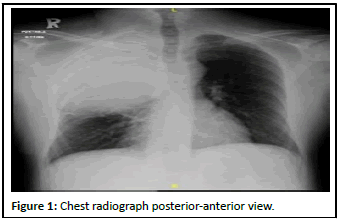
Figure 1: Chest radiograph posterior-anterior view
Further evaluation with an IV contrast enhanced chest CT scan demonstrated a heterogeneous, enhancing hyper-vascular mediastinal mass located in the right paratracheal region.
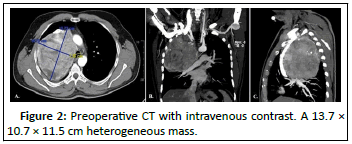
Figure 2: Preoperative CT with intravenous contrast. A 13.7 × 10.7 × 11.5 cm heterogeneous mass.
The mass exhibited areas of cystic degeneration and calcification, along with an independent normally located thyroid gland with a thyroid nodule (Figure 2). A CT-guided biopsy of the mass was performed, and the results revealed positive staining for Thyroglobulin and Thyroid Transcription Factor 1 (TTF-1). Thyroid-Stimulating Hormone (TSH) and serum free T4 levels were within normal limits. Based on the diagnostic findings, a diagnosis of ectopic mediastinal thyroid was made, and the patient was consented for surgery.
Surgical approach
Surgery was planned following the diagnosis. A double-lumen endotracheal tube was used for lung isolation, ensuring adequate ventilation and safety during the procedure. The patient was placed in the left lateral position, and a right posterolateral thoracotomy was performed. During the surgery, the mass was found to be adherent to several structures, including the lung parenchyma, posterior mediastinal pleura, right main bronchus, azygous vein, and superior vena cava. The upper border of the gland was lying below the 2nd rib.
A complete surgical excision of the mass was performed, with en-bloc resection of the imbedded azygous vein. Multiple arterial branches originating from the intercostal arteries were carefully ligated to control bleeding. Given the mass's extensive vascular supply and adhesion to surrounding structures, meticulous dissection was required to ensure the removal of the mass without compromising nearby vital structures.
The patient experienced an uneventful recovery and was discharged on post-operative day three. Gross examination of the excised mass revealed an encapsulated dark red multinodular structure, measuring 15 × 12 × 9 cm, with a firm consistency and weighing 950 grams. Histopathological analysis of the mass confirmed the presence of thyroid tissue.
Discussion
In humans, the organogenesis of the thyroid gland can be disturbed, leading to a variety of conditions, such as agenesis, ectopy and hypoplasia, which are collectively called thyroid dysgenesis [4]. Any disease affecting the thyroid gland may also involve the ectopic thyroid, including malignancy [5]. There are two forms of mediastinal thyroid reported in the literature: primary mediastinal goiters, which account for less than 1% of intrathoracic goiters [9], and secondary mediastinal goiters, which are far more common and result from the downward growth of the normally located cervical gland. Secondary mediastinal goiters often receive their blood supply from the cervical branches of the thyroid arteries. The incidence of secondary mediastinal goiters can vary widely, from 2% to 20%, depending on the definitions and reporting standards used [6-8].
In the context of Giant Mediastinal Ectopic Thyroids (GM-ETT), the term "giant" refers to a mass with a long axis greater than 10 cm, though definitions may vary. While size can be a factor in symptomology, most patients with these masses experience symptoms due to compression of adjacent structures rather than solely the size of the mass itself (Table 1).
| Case |
Age |
Gender |
Site |
Symptom |
Thyroid function |
CT chest |
Biopsy |
Longest axis |
Approach |
Pathology |
Reference |
| 1 |
28 |
M |
Right |
Dysphagia, hoarsness |
Normal |
Yes |
Yes |
12 cm |
Not mentioned |
Goitre |
Chaudhry IU, et al. |
| 2 |
35 |
F |
Right |
Cough, chest pain |
Abnormal |
Yes |
Yes |
11.5 cm |
Sternotomy with cervical extension |
Goitre |
Muzurovi E, et al. |
| 3 |
44 |
M |
Right |
Hemoptysis, orthopnea |
Normal |
Yes |
Yes |
12 cm |
Thoracotomy |
Goitre |
Sunam GS, et al. |
| 4 |
39 |
M |
Right |
Asymptomatic |
Normal |
Yes |
Yes |
15 cm |
Thoracotomy |
Goitre |
Our case |
Table 1: 4 cases of giant ectopic mediastinal thyroid.
Surgical resection of ectopic thyroid masses, particularly large ones, presents challenges due to the involvement of critical thoracic structures. In this case, the vascular supply to the ectopic thyroid was particularly complex, originating from the intercostal arteries and draining into the azygous vein and paravertebral venous plexus. Careful management of these structures during surgery was essential to avoid damage and ensure a successful excision [10-11].
Surgical considerations and complications:
• Vascular management: The vascular supply to ectopic thyroids can be extensive, especially when the mass is large. Surgical planning must account for ligating arterial branches and managing venous drainage. The use of a double-lumen endotracheal tube is essential to isolate the lungs and minimize the risk of respiratory complications.
• Adhesion to surrounding structures: Ectopic thyroid masses often adhere to vital structures such as the pleura, lung, and large vessels. Dissection must be performed carefully to minimize the risk of inadvertent injury, especially in masses with extensive fibrosis or calcification.
• Post-operative care: Given the extensive nature of the surgery, close monitoring postoperatively is necessary to ensure that the patient remains stable and to watch for any complications such as bleeding or respiratory distress.
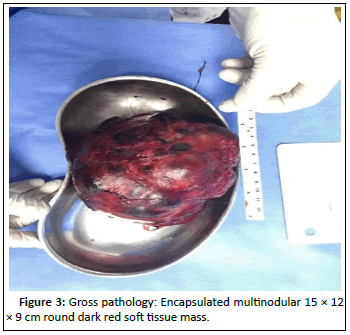
Figure 3: Gross pathology: Encapsulated multinodular 15 × 12 × 9 cm round dark red soft tissue mass.
Conclusion
In conclusion, this case highlights the incidental finding of a giant ectopic thyroid mass in the posterior mediastinum. Surgical excision through a right posterolateral thoracotomy was essential for the patient's recovery. This case report underscores the importance of early detection, accurate diagnosis, and timely intervention in managing such rare mediastinal masses. Ectopic thyroid in the mediastinum is a rare pathology and can be associated with normal thyroid function. It should be considered as a differential diagnosis in patients presenting with mediastinal masses, particularly in cases where thyroid function is normal.
This case contributes to the limited body of literature on GMETT, and further cases are warranted to enhance our understanding of this condition and improve patient care.
Consent
Informed consent was obtained from the patient for publication of this case report and accompanying image IRB 23-605.
Acknowledgment
None.
Funding
The authors didn't receive any financial support for this report.
References
- Verma N, Abishegam SD, Ahmad AR (2019) Ectopic thyroid tissue presenting as an external auditory canal mass. Int J Otorhinolaryngol Head Neck Surg 5:476-478
[Crossref] [Google Scholar]
- Santangelo G, Pellino G, de Falco N, Colella G, D'Amato S, et al. (2016) Prevalence, diagnosis and management of ectopic thyroid glands. Int J Surg 28:S1-S6
[Crossref] [Google Scholar] [PubMed]
- de Souza FM, Smith PE (1983) Retrosternal goiter. J Otolaryngol 12:393-396
[Google Scholar] [PubMed]
- de Felice M, di Lauro R (2004) Thyroid development and its disorders: Genetics and molecular mechanisms. Endocr Rev 25:722-746
[Crossref] [Google Scholar] [PubMed]
- Noussios G, Anagnostis P, Goulis DG, Lappas D, Natsis K (2011) Ectopic thyroid tissue: Anatomical, clinical, and surgical implications of a rare entity. Eur J Endocrinol 165:375-382
[Crossref] [Google Scholar] [PubMed]
- Newman E, Shaha AR (1995) Substernal goiter. J Surg Oncol 60:207-212
[Crossref] [Google Scholar] [PubMed]
- von Haller A (1747) Disputationes anatomicae selectae. Vandenhoeck 96
[Google Scholar]
- Klein F (1820) Veber die Austrotting verschiedener geschwulste, besonders jener der Ohrspercheldruse und der Schiddruse; Aussachalung der Schilddruse. J Chir Augenlleilk 12:106-113
[Google Scholar]
- Sunam GS, Oncel M, Ceran S, Odev K, Yıldıran H (2016) Giant benign mediastinal masses extending into the pleural cavity. Surg J 2:e46-e50
[Crossref] [Google Scholar] [PubMed]
- Muzurovic E, Smolovic B, Miladinovic M, Muhovic D, Campar B (2021) Diagnosis and treatment of mediastinal ectopic thyroid tissue with normally located thyroid gland and primary hyperparathyroidism: A case report. Gland Surg 10:1532
[Crossref] [Google Scholar] [PubMed]
- Chaudhry IU, Cheema AI, AlShamasi Z, Mutairi H (2016) Hoarseness of voice, respiratory distress and dysphagia due to giant primary posterior mediastinal ectopic goitre: A rare clinical entity. BMJ Case Rep 2016:bcr2016215132
[Crossref] [Google Scholar] [PubMed]
Copyright: Abu-Daff SN, Hussein HS, Hafez B, Shah IA, Abbas MA (2025) Giant Ectopic Thyroid Mass: A Case Report and Review of the Literature. J Univ Surg Vol:13 No:1