Research Article - (2025) Volume 19, Issue 6
Advancements in Neuroprosthetics and Brain-Machine Interfaces
Satyam Thakur*
Department of Pharmacy, Banaras Hindu University, Varanasi, Uttar Pradesh, India
*Correspondence:
Satyam Thakur, Department of Pharmacy, Banaras Hindu University, Varanasi, Uttar Pradesh,
India,
Email:
Received: 08-Oct-2024, Manuscript No. IPHSJ-24-15257;
Editor assigned: 10-Oct-2024, Pre QC No. IPHSJ-24-15257 (PQ);
Reviewed: 24-Oct-2024, QC No. IPHSJ-24-15257;
Revised: 18-Jun-2025, Manuscript No. IPHSJ-24-15257 (R);
Published:
25-Jun-2025
Abstract
Neuroprosthetics and Brain-Machine Interfaces (BMIs) constitute significant advancements in biomedical engineering, offering innovative solutions for people with neurological impairments. This study investigates the latest developments in these technologies, focusing on improvements in signal fidelity, real-time processing, and biocompatibility. While neuroprosthetics aim to restore lost sensory and motor functions, BMIs facilitate direct communication between the brain and external devices, enhancing control and interaction. Despite notable progress, challenges persist, including signal accuracy, device integration, and ethical considerations. This study examines recent advancements, elucidates key innovations, and proposes future directions to overcome existing limitations, ultimately aiming to improve the quality of life of people with disabilities.
Keywords
Neuroprosthetics; BMIs; EEG; Electrodes; External device
Introduction
Neuroprosthetics and Brain-Machine Interfaces (BMIs) are advanced technologies designed to assist individuals with neurological impairments in regaining lost function or enhancing their capabilities. Neuroprosthetics are devices that directly interface with the nervous system to replace or improve lost sensory and motor function [1-3]. In contrast, BMIs set up a direct communication pathway between the brain and external devices, enabling people to control computers, robotic limbs, and assistive technologies through neural activity. The significance of these technologies lies in their potential to transform the lives of millions by restoring independence and improving the quality of life (Figure 1).
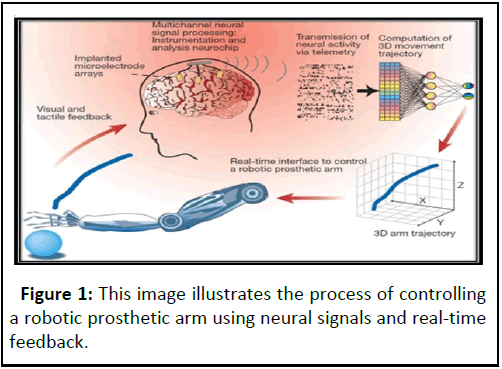
Figure 1: This image illustrates the process of controlling a robotic prosthetic arm using neural signals and real-time feedback.
Materials and Methods
Recent studies have focused on various aspects of neuroprosthetics and BMIs, highlighting their technological advancements and applications. Discussed recent advancements in neural signal decoding and encoding technologies, emphasizing how they relate to neuroprosthetics [4]. Saha et al. reviews advances in signal processing and device integration in the Indian context, providing insight into local developments in the field. Zhang et al. explored improvements in real-time signal processing for BMIs, emphasizing the importance of immediate responsiveness in practical applications [5]. However, challenges such as high costs, limited accessibility, and ethical considerations persist and require further research (Figure 2).
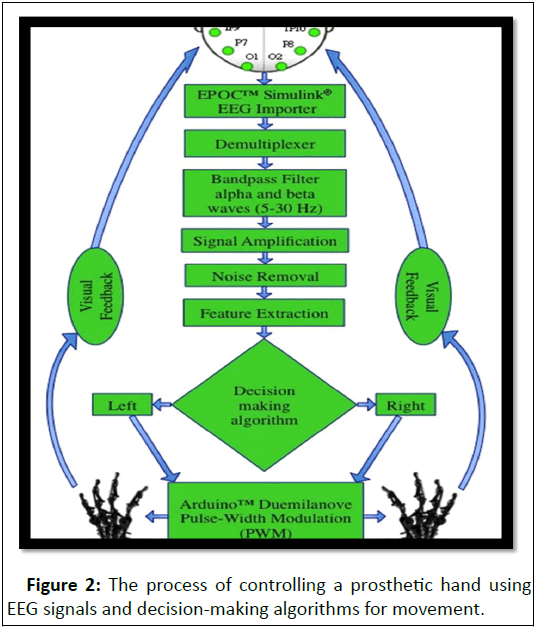
Figure 2: The process of controlling a prosthetic hand using EEG signals and decision-making algorithms for movement.
Proposed system architecture
The proposed system integrates neural signal acquisition, signal processing, command execution, and feedback (Figure 3).
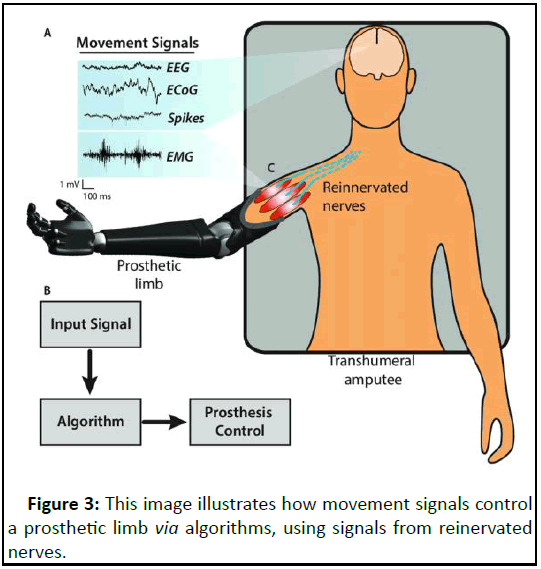
Figure 3: This image illustrates how movement signals control a prosthetic limb via algorithms, using signals from reinervated nerves.
Signal acquisition: Neural signals are acquired using either invasive (e.g., implanted electrodes) or noninvasive methods (e.g., EEG sensors). These sensors detect the electrical activity generated by neurons during movement intentions.
Signal processing: The acquired signals undergo preprocessing to reduce noise and artifacts. Advanced machinelearning algorithms decode neural signals into actionable commands and interpret the user's intended movements.
Command, generation: The decoded signals were transmitted to an external prosthetic device, enabling the user to execute natural movements. Certain systems also incorporate a feedback loop to transmit sensory information back to the user (Figure 4).
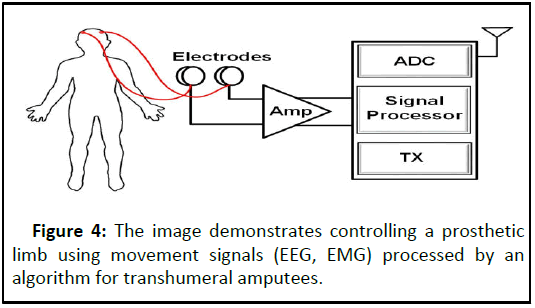
Figure 4: The image demonstrates controlling a prosthetic limb using movement signals (EEG, EMG) processed by an algorithm for transhumeral amputees.
System, workflow
• Step 1: Signal acquisition neural sensors.
• Step 2: Signal preprocessing for noise filtering.
• Step 3: Decoding utilizing machine-learning algorithms.
• Step 4: Command execution to control the device.
• Step 5: Sensory feedback is transmitted to the user (Figure 5).
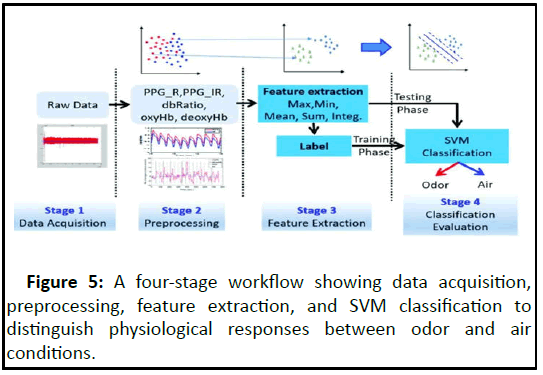
Figure 5: A four-stage workflow showing data acquisition, preprocessing, feature extraction, and SVM classification to distinguish physiological responses between odor and air conditions.
Results
The implementation of the proposed system demonstrated promising outcomes in initial trials, with participants exhibiting improved control and responsiveness when utilizing advanced neuroprosthetics [6,7]. The integration of sensory feedback has enhanced the user experience, providing a more naturalistic interaction with the environment (Figure 6).
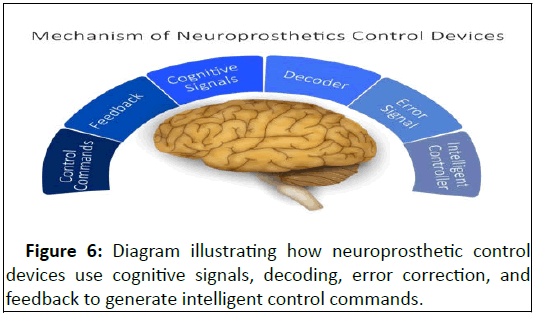
Figure 6: Diagram illustrating how neuroprosthetic control devices use cognitive signals, decoding, error correction, and feedback to generate intelligent control commands.
Discussion
Advancements in neuroprosthetics and BMIs represent a significant progression in assistive technology, offering potential solutions to the challenges faced by people with disabilities [8]. However, ongoing challenges persist, including the need for further improvements in signal fidelity and long-term biocompatibility [9]. Ethical considerations as to privacy and societal implications of these technologies must also be addressed to ensure responsible development and application (Figure 7).
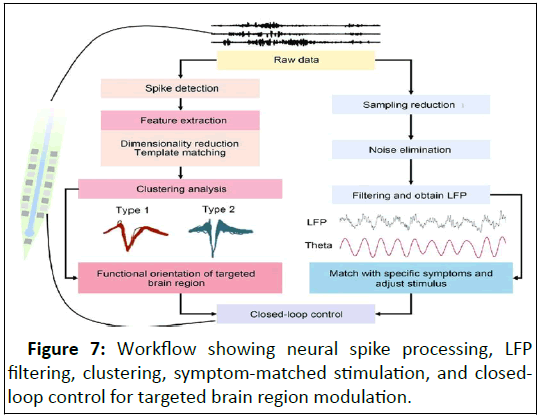
Figure 7: Workflow showing neural spike processing, LFP filtering, clustering, symptom-matched stimulation, and closedloop control for targeted brain region modulation.
Conclusion
Neuroprosthetics and BMIs possess the potential to revolutionize the treatment of neurological impairments by restoring lost function and enhancing user control.
Although significant advancements have been achieved, further research is required to address existing challenges and explore novel applications. By focusing on innovative technologies and ethical considerations, the future of neuroprosthetics and BMIs holds considerable promise in improving the quality of life of people with disabilities.
Future Scope
Advancements in non-invasive systems: Future research endeavors will focus on enhancing non-invasive methodologies, with the aim of achieving comparable efficacy to invasive solutions.
Integration of artificial intelligence: Implementing AI technologies to enhance signal decoding accuracy and optimize user experience.
Development of wireless technologies: Incorporating wireless communication systems to reduce complexity and enhance mobility.
Ethical considerations: Addressing privacy concerns and ethical implications as these technologies become increasingly integrated into daily life.
Broader applications: Investigating potential applications beyond traditional prosthetics, including rehabilitation and human-computer interaction.
References
- Saha S, Ghosh A, Prasad S (2023) Neuroprosthetics: Advances in signal processing and device integration in Indian context. Int J Biomed Eng Technol 39: 265-280.
[Google Scholar]
- Lebedev MA, Nicolelis MAL (2022). Decoding and encoding brain activity: Recent advances. Nat Rev Neurosci 23: 209-223.
[Google Scholar]
- Zhang Y, He H, Wang X (2024) Real-time signal processing in brain-machine interfaces. Front Neurosci 18: 762493.
- Smith JA, Lee Y, Zhao M (2023) Machine learning approaches in neuroprosthetics. J Neural Eng 20: 045003.
- Sani Y, Hashemi S (2022) Neuroprosthetics: from sensorimotor to cognitive disorders. Commun Biol 5: 131.
- Nicolelis MAL (2021) Brain–machine–brain interfaces as the foundation for the next generation of neuroprostheses. Natl Sci Rev 9: nwab206.
[Crossref] [Google Scholar] [PubMed]
- Aubert A, Gouret A, Waszak F, Le Bars S, Chokron S, et al. (2024) Advancements in brain-computer interfaces for the rehabilitation of unilateral spatial neglect. Front Neurosci 18: 1373377.
[Crossref] [Google Scholar] [PubMed]
- Vidal JR, Rynes M (2016) Review of brain-machine interfaces ussed in neural prosthetics with high-density recordings and decoding. Front Neurosci.
[Google Scholar]
- Zhu B, Shin U, Shoaran M (2021) Closed-loop neural prostheses with on-chip intelligence: a review and low-latency machine-learning model for brain-state detection.
[Google Scholar]
References
- Saha S, Ghosh A, Prasad S (2023) Neuroprosthetics: Advances in signal processing and device integration in Indian context. Int J Biomed Eng Technol 39: 265-280.
[Google Scholar]
- Lebedev MA, Nicolelis MAL (2022). Decoding and encoding brain activity: Recent advances. Nat Rev Neurosci 23: 209-223.
[Google Scholar]
- Zhang Y, He H, Wang X (2024) Real-time signal processing in brain-machine interfaces. Front Neurosci 18: 762493.
- Smith JA, Lee Y, Zhao M (2023) Machine learning approaches in neuroprosthetics. J Neural Eng 20: 045003.
- Sani Y, Hashemi S (2022) Neuroprosthetics: from sensorimotor to cognitive disorders. Commun Biol 5: 131.
- Nicolelis MAL (2021) Brain–machine–brain interfaces as the foundation for the next generation of neuroprostheses. Natl Sci Rev 9: nwab206.
[Crossref] [Google Scholar] [PubMed]
- Aubert A, Gouret A, Waszak F, Le Bars S, Chokron S, et al. (2024) Advancements in brain-computer interfaces for the rehabilitation of unilateral spatial neglect. Front Neurosci 18: 1373377.
[Crossref] [Google Scholar] [PubMed]
- Vidal JR, Rynes M (2016) Review of brain-machine interfaces ussed in neural prosthetics with high-density recordings and decoding. Front Neurosci.
[Google Scholar]
- Zhu B, Shin U, Shoaran M (2021) Closed-loop neural prostheses with on-chip intelligence: a review and low-latency machine-learning model for brain-state detection.
[Google Scholar]
Citation: Thakur S (2025) Advancements in Neuroprosthetics and Brain-Machine Interfaces. Health Sci J Vol:19 No:6