Research Article - (2025) Volume 19, Issue 6
Telephone Follow-up in Hand Surgery-Can One Surgeons Change of Practice Make an Environmental and Economic Impact?
RA Fawdry1*,
O Stapleton2,
E Wardle3,
C Sook3 and
A Kocheta1
1Department of Orthopaedics, Rotherham General Hospital, Rotherham, UK
2Department of Medicine, University of Sheffield Medical School, Sheffield, UK
3Department of Business Analytics, Rotherham General Hospital, Rotherham, UK
*Correspondence:
RA Fawdry, Department of Orthopaedics, Rotherham General Hospital, Rotherham,
UK,
Email:
Received: 22-Oct-2024, Manuscript No. IPHSJ-24-15277;
Editor assigned: 24-Oct-2024, Pre QC No. IPHSJ-24-15277 (PQ);
Reviewed: 11-Nov-2024, QC No. IPHSJ-24-15277;
Revised: 18-Jun-2025, Manuscript No. IPHSJ-24-15277 (R);
Published:
25-Jun-2025
Abstract
Background: NHS England produces around 24.9 million tonnes of CO2 each year and its mission to work towards net zero requires each of us to do our part. Orthopaedics contributes 20% of the carbon emissions of the NHS, so the focus on ‘reduce, reuse, recycle’ in our specialty is important. The COVID-19 pandemic introduced telephone appointments to manage a range of conditions and have been shown to both be satisfying to patients but also capable of achieving good outcomes whilst having an environmental impact. We looked at how one surgeons’ change in practice has led to environmental and economic savings.
Methods: All patients who had undergone telephone follow up in the surgeon’s clinics in the period March 2020-March 2023 were retrospectively identified. The case notes were reviewed for condition, treatment and whether further follow up was required. The data was interrogated to determine travel distance and socioeconomic deprivation status of their postcode.
Results: In total 118 telephone appointments were carried out in the study period. 6 were excluded due to not sharing the address. Of the 112, 37.5% were for carpal tunnel syndrome, 62% were post op and 25% were post injection. 28 patients (26%) needed secondary face to face follow up, with no significant difference between post op or post injection (p=0.15). A total of 1,284 travel miles were avoided, saving 0.33 tonnes of CO2. 39.3% of patients came from the most deprived quintile of postcodes.
Discussion: Our results suggest that through a single surgeon changing practice, a significant saving of carbon emissions can be achieved. The potential for this to be multiplied through the whole NHS is vast. This also represents an important cost saving in travel and time passed on to patients, especially those patients from more deprived areas, without an impact on patient care.
Keywords
Surgeons; Orthopaedics; NHS; COVID-19; Chi-Square
Introduction
The NHS in England produces 24.9 million tonnes of carbon dioxide each year, which is about 4% of England’s total carbon footprint. In January 2020 the campaign for a greener NHS was launched with the aim of not only cutting emissions but also working towards a net zero NHS by 2040 [1]. The report stresses the importance of each individual doing their part to cut emissions, with emissions broken down into several areas. Scope 1 emissions are the direct emissions from the NHS such as NHS facilities, anaesthetic gases and powering the NHS fleet. Scope 2 emissions are those indirect emissions generated from making the electricity used by the NHS. Scope 3 emissions are not directly produced by the NHS but result from its activities. The NHS net zero pledge splits these scope 3 emissions into the NHS carbon footprint and carbon footprint plus. The carbon footprint includes areas such as waste, water and business travel. Carbon footprint plus includes other scope 3 emissions like medical devices, including implants, medicines, ICT, staff commuting and freight transport. It also includes in the footprint plus pledge emissions outside the previous scopes of patient and visitor travel. The NHS has pledged to be net zero in carbon footprint plus by 2045. Orthopaedic surgery as a specialty contributes 20% of the total carbon footprint of the NHS and this has become a particular focus of the British Orthopaedic Association in creating a sustainable future for orthopaedics through the concepts of: Reduce, reuse and recycle. Particular areas of focus include within scope 3 emissions where savings can be made through water use, waste production and implant choices. Within hand surgery, one of the most common procedures, carpal tunnel decompression, has been shown to create 12 kg of carbon dioxide per procedure, mainly from single use drapes [2]. Reducing the environmental impact of our surgery is multifaceted, and whilst the surgical equipment and drapes etc. can be improved, there are other ways to reduce the carbon footprint of the procedure, particularly through looking at outpatients follow up practices.
The COVID-19 pandemic of 2020-2023 has catalysed a greater number of telephone consultations across all specialties. Within hand surgery, studies during the COVID-19 pandemic showed that both patients and surgeons were satisfied with telemedicine appointments, with patients finding it ‘very easy’ to schedule their appointments [3]. This has been backed up in other studies, with one showing that 52% of patients preferred telemedicine appointments and another showing no difference in patient satisfaction with telemedicine or face to face appointments [4,5]. Since these practices were adopted during the COVID-19 pandemic the ongoing use of telephone appointments has been shown to be effective in follow up in hand surgery. One study demonstrated 75% of telephone appointments being successful (the same outcomes being able to be achieved as face to face) but also showed a saving of 1.25 tonnes of carbon dioxide. Some studies have even demonstrated that there is higher patient satisfaction with telephone appointments compared to face to face in elective hand surgery follow up [6]. Telephone follow up of some routine, predictable conditions such as carpal tunnel decompression shows favourable outcomes in the literature with one study showing not only 93% patient satisfaction but also a cost saving of £277,022 to the department over 7 years. Whilst the cost to the department is important, the cost to patients also should be considered, especially time, transport and parking. In 2018/19 the NHS made £185.6 million from patient and visitor car parking.
Whilst this study focuses on the carbon emissions from patient travel to appointments, there are other areas where environmental savings can be made such as streamlining theatre instrument packs, reducing waste and water use. Thiel et al. demonstrate the use of a minimal custom pack for hand surgical procedures, creating 13% less waste and also 55% cost savings compared to standard packs without sacrificing clinical outcomes or patient satisfaction [7]. Significant amounts of waste are produced during orthopaedic procedures, particularly through the use of disposable gowns and drapes, with changing to reusable gowns being demonstrated to save around 66% of carbon emissions vs. disposable. Finally, using infrared sensors switch taps on to prevent water waste when scrubbing can save as much water each year as a medium sized city whilst waterless hand rub has been shown to be as effective as chlorhexidine scrub in elimination of colony forming units of bacteria. These studies all highlight potential other opportunities for environmental benefits for surgeons to consider.
Our department has already taken steps to reduce our environmental impact. Our main hand theatres use sensor taps to reduce water waste during hand washing. We have also transitioned to using reusable gowns rather than disposable. Given that we carry out on average 1400 procedures a year this leads to savings of 82,425 litres of water and 4.42 tonnes of CO2 each year due to the changes already made [8]. A further area where we have taken steps to counter CO2 production is through rationalisation of theatre packs. A small tray for carpal tunnel decompressions and trigger finger releases, which contains 14 instruments rather than the usual 55 on a basic hand tray. This saves 3 kg of CO2 per tray, and 669.3 kg of CO2 a year.
However, we continue to work towards net zero so other areas of saving are important. During the early stages of the COVID-19 pandemic, the use of telephone appointments was adopted locally by our department. The lead investigator has continued to use telephone follow-up appointments as part of his routine out-patient clinic practice. Telephone appointments are used in place of face-to-face follow up appointments where:
• There is a decision to be made with the patient on a treatment plan and no new investigations or examination is required.
• For follow up after treatment where the post-treatment course is predictable and regular wound reviews are not required.
• Where no significant communication barriers might occur to telephone consultation e.g., language barriers, hearing impairment, vocal impairment, mental capacity, etc.
This study looked at those patients that had telephone appointments over a 3-year period with reference to environmental and patient-related savings made.
Materials and Methods
All patients who had undergone telephone appointments within the individual surgeon’s clinic over a 3-year period from March 2020 to March 2023 were retrospectively identified. This included both elective and fracture clinics. Following identification of the patients, the case notes were reviewed to determine the condition treated, post-op or post-injection status and whether further face to face appointments were required subsequently for that condition. The patient demographic information was interrogated for their home address, which allowed calculation of journey distance, identification of the socioeconomic deprivation status of the postcode and estimation of carbon footprint of the journey. Carbon footprint was estimated using a carbon footprint calculator [9]. Journeys were estimated as 80% made by personal car, 20% by public transport (10% taxi, 10% bus) as this correlates with the ONS data on car ownership in our region of 23% households not owning a car or van. Environmental impact assessments are complex and present a challenge in correctly quantifying, and the authors recognise the limitations of using a commercially available carbon emissions calculator and assumptions based on census data. Patients were excluded if they declined to share their address with the hospital. Statistical tests were carried out using SPSS with a paired T-test used to compare further appointment rates between post injection and post op patients and a Chi-Squared test to compare face to face follow up within the post-operative and post-injection groups.
Results
A total of 118 telephone appointments were carried out over the 3-year period, which accounted for 8.5% of the 1,384 telephone appointments carried out at our hospital in that time and 2.2% of the 5268 appointments carried out by the surgeon [10]. 6 patients did not share their address with the hospital so were excluded as was one patient who was contacted after a hip hemi arthroplasty as part of the general trauma service, leaving 111 patients. Of the 111 patients identified, the case notes were unavailable for 3. Conditions followed up were as shown in Table 1, with the majority being carpal tunnel syndrome.
|
Condition
|
Count
|
|
Carpal tunnel syndrome
|
42
|
|
Base of thumb or STT OA
|
14
|
|
Excision of ganglion
|
4
|
|
Wrist arthroscopy and synovectomy
|
2
|
|
Extensor tendon release
|
2
|
|
DIPJ fusion
|
1
|
|
Finger amputation
|
1
|
|
Phalanx fracture
|
1
|
|
Thumb MCPJ UCL injury
|
1
|
|
Ankle fracture and hindfoot nail
|
1
|
|
Trigger sigits
|
25
|
|
De Quervains Tenosynovitis
|
4
|
|
Distal radius fracture
|
3
|
|
Removal of metalwork/foreign body
|
2
|
|
Wrist pain
|
2
|
|
Giant cell tumour excision
|
1
|
|
Carpal dislocation repair
|
1
|
|
Flexor tendon repair
|
1
|
Table 1: Conditions followed up via telephone appointment.
Of the 108 patients, 67 were post op (62%) and 27 were post injection (25%). In total 28 patients needed face to face follow up after their telephone appointment, which accounted for 26% of all patients. 15 post op patients (22%, p=0.23) had subsequent face to face follow up, compared to 8 post injection patients (30%, p=0.61). There was no significant difference between the two groups (p=0.15). Reasons for face to face follow up were mainly related to a requirement to examine the patient or to request further radiographs to decide on further treatment. A small group were asked to return for face to face follow up due to communication issues including an occasional inability of patients to adequately describe their symptoms or anatomy.
The patient’s address was mapped out and the shortest distance to the hospital determined. In total, 1,284 miles of travel were saved by using telephone follow up. Based on census data of car ownership where 23% of households in the studied postcodes did not own a car, 80% were presumed to have travelled by personal car, 10% by taxi and 10% by public transport. Whilst accepting the generalisation of different vehicle emissions can vary, the carbon footprint calculator estimates were accepted (Table 2). Using this, the telephone appointments saved a minimum of approximately 0.33 tonnes of CO2 emissions [11].
| Transport method |
Estimated miles travelled |
CO2 emission per mile (g/mile) |
Total CO2 emissions (tons) |
| Personal car |
1027.2 |
268 |
0.28 |
| Taxi |
128.4 |
268 |
0.03 |
| Public transport |
128.4 |
155 |
0.02 |
Table 2: CO2 Emissions by transport method.
The additional bonus is the economic saving for the patients, with reduced need for car usage, bus tickets, taxi fares and also a total saving of between £197-300 on parking fees for 30 mins-2 hours parking. Another factor to consider in economic savings of using telephone consultations is the time saving for the patient, including travel time and time waiting in the hospital (Table 3). With travel speeds around the urban area decreasing year on year, even a short journey can take time. Telephone consultations can prevent the patient having to take time off work for appointments and provide economic benefit in that regard.
|
Component
|
Average travel speed
|
Number of miles
|
Average time (h)
|
Average time per patient (h)
|
|
Travel
|
13.28
|
1284
|
96:41:00
|
00:54
|
|
Appointment
|
-
|
-
|
81
|
00:45
|
|
Total
|
-
|
-
|
177:41:00
|
01:39
|
Table 3: Average travel time and time savings.
We were able to map our patients based on the deprivation score of the postcode area (Figure 1), with 39% coming from the most deprived quintile in Yorkshire and Humber and a further 16% coming from the second most deprived quintile [12].
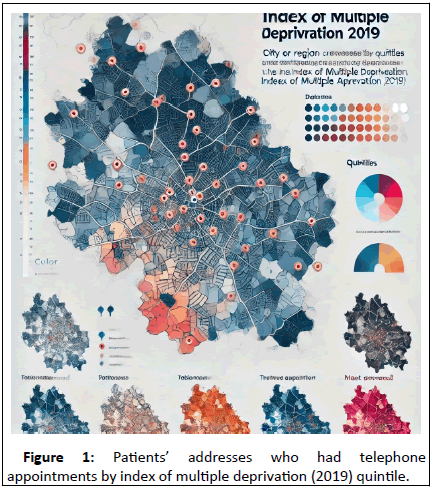
Figure 1: Patients’ addresses who had telephone appointments by index of multiple deprivation (2019) quintile.
In the 3 months following the study period, our surgeon’s practice had increased the telephone follow up percentage of patients to around 25%. If we extrapolate the data, the annual savings for this would represent 1.375 tons CO2/year, 5350 miles of travel and £820 - £1250 in parking fees.
Discussion
Working towards the greener NHS targets requires each of us to do our part. The adage of ‘reduce, reuse and recycle’ is important to keep at the forefront of our practice. Our unit has already implemented a number of measures to assist in this including sensor taps, saving 82,425 litres of water a year and also re-usable gowns, saving 4.42 tonnes of CO2 each year. The streamlining of trays saves a further 669 kg of CO2 each year. A further way to ‘reduce’ is through reducing the travel for our patients to appointments. Even prior to the COVID-19 pandemic, studies were showing the benefits of telephone appointments in select hand surgery cases, with one study in carpal tunnel decompression showing a 93% patient satisfaction rates and cost saving to the hospital department of £45,958 over two years where all carpal tunnel follow-up appointments are undertaken this way. Some centres have even tried using telephone appointments in diagnosis of carpal tunnel syndrome, with one study showing no disagreement between virtual diagnosis and face to face assessment on the day of surgery. We have found the use of telephone appointments for initial consultations to be unsatisfactory and use them only for followup consultations where the post-intervention course is more predictable or where specific decisions are to be made with the patient without further investigations or examination being required [13]. The use of telephone appointments has also been shown to reduce the cost of healthcare in hand and wrist surgery when comparing billing records for telephone appointments and matched individuals. It is the impression of the surgical team that telephone consultations are more timeefficient in the clinic but specific data on this anecdotal saving has not been collected.
The COVID-19 pandemic helped change practice for a number of units and surgeons, and the ongoing use of telephone appointments has not only been shown to be successful in outcomes, but also saves carbon emissions through reduced travel. The change in practice by our single surgeon has led to a significant saving of 0.33 tonnes of carbon dioxide emissions over three years, which if extrapolated with the current figures across the hand unit of three surgeons would save a minimum of a 0.33 tonnes of CO2 annually. Our single surgeon’s practice has also increased the use of telephone appointments, in the last 3 months since the study period ended, 25% of elective follow ups have been via telephone, which will lead to even greater savings, in the region of represent 1.375 tons CO2/year, 5350 miles of travel and £820 - £1250 in parking fees.
Whilst 29.5% of our patients undergoing telephone follow up came from the 40% of areas of lowest deprivation, 55.4% were from the most deprived 40% of areas. By not only saving CO2 emissions, but also passing on savings of time and money to those patients from the more deprived areas, an even greater positive socioeconomic impact has been discovered by this change of practice.
Conclusion
The authors accept that whilst we have only demonstrated a moderate saving in the study period, the projected savings due to the change in practice will be significant. As discussed earlier in this paper there are other areas where this hand unit can provide environmental savings such as energy from washing gowns by allowing patients undergoing Wide Awake Local Anaesthetic with No Tourniquet (WALANT) to enter theatre in their outdoor clothes. Subsequent papers will assess the impact of these changes.
We have shown that a single surgeon’s change in practice, can lead the way for others to follow suit, making an impact on not only the environmental but also the socio-economic cost of hand surgery.
References
- Moses MJ, Buchalter DB, Azad A, Hacquebord JH, Paksima N, et al. (2021) Telemedicine during the COVID-19 pandemic: A hand surgery perspective. J Hand Surg Asian Pac Vol 26: 705-715.
[Crossref] [Google Scholar] [PubMed]
- Hendrickson SA, Witt P, Watts A (2021) Telephone clinics for follow-up in hand surgery: An effective model after COVID-19?. Bull R Coll Surg Engl 103: 258-262.
[Crossref] [Google Scholar]
- Rizan C, Lillywhite R, Reed M, Bhutta MF (2023) The carbon footprint of products used in five common surgical operations: Identifying contributing products and processes. J R Soc Med 116: 199-213.
[Crossref] [Google Scholar] [PubMed]
- Ahmad F, Wysocki RW, Fernandez JJ, Cohen MS, Simcock XC (2023) Patient perspectives on telemedicine during the COVID-19 pandemic. Hand 18: 522-526.
[Crossref] [Google Scholar] [PubMed]
- Bartoletta JJ, Hinchcliff KM, Rhee PC (2023) Comparison of patient perception and satisfaction of face-to-face versus telemedicine encounters in hand surgery. Hand 18: 673-679.
[Crossref] [Google Scholar] [PubMed]
- Parwaiz H, Trew C, Sheriff M, Langdon I (2022) Patient satisfaction with face-to-face follow-up versus telephone follow-up after elective day case hand surgery. J Hand Surg Asian Pac Vol 27: 105-109.
[Crossref] [Google Scholar] [PubMed]
- Leung C, Magan A, Williams M, Chojnowski A, Chapman P (2014) Telephone Clinic follow-up following carpal tunnel Decompression: A 7-Year Review Of Service: 1272. Int Surg J 12: S66.
[Google Scholar]
- Thiel CL, Fiorin Carvalho R, Hess L, Tighe J, Laurence V, et al. (2019) Minimal custom pack design and wide-awake hand surgery: Reducing waste and spending in the orthopedic operating room. Hand 14: 271-276.
- Kara A, Yasar C, Birinci M, Gulenc B, Sener B (2021) Don't let our operating theatre to be desert. Acta Chir Orthop Traumatol Cech 88: 229-32.
[Google Scholar] [PubMed]
- Tsai JC, Lin YK, Huang YJ, Loh EW, Wen HY, et al. (2017) Antiseptic effect of conventional povidone–iodine scrub, chlorhexidine scrub, and waterless hand rub in a surgical room: A randomized controlled trial. Infect Control Hosp Epidemiol 38: 417-422.
[Crossref] [Google Scholar] [PubMed]
- Rizan C, Lillywhite R, Reed M, Bhutta MF (2022) Minimising carbon and financial costs of steam sterilisation and packaging of reusable surgical instruments. Br J Surg 109: 200-210.
[Crossref] [Google Scholar] [PubMed]
- Williams M, Amin A, Getgood A, Hallam P, Chojnowski J, et al. (2008) Telephone clinic follow-up following carpal tunnel decompression. J Hand Surg Eur Vol 33: 641-644.
[Crossref] [Google Scholar] [PubMed]
- Grandizio LC, Rocha DFB, Foster BK, Udoeyo IF (2022) Evaluation of a comprehensive telemedicine pathway for carpal tunnel syndrome: A comparison of virtual and in-person assessments. J Hand Surg Am 47: 111-119.
[Crossref] [Google Scholar] [PubMed]
Citation: Fawdry RA, Stapleton O, Wardle E, Sook C, Kocheta A (2025) Telephone Follow-up in Hand Surgery-Can One Surgeons Change of Practice Make an Environmental and Economic Impact? Health Sci J Vol:19 No:6